Wet Dog Glass
HISTORY OF WET DOG GLASS
From an early age Eddie Bernard enjoyed working with his hands and figuring out how things are put together. When he was 10 years old, his mother, an artist working primarily in clay and paper, had an interest in the sawdust fired pottery of Maria Martinez and other Native American potters of San Ildefonso Pueblo, NM, so they traveled to the pueblo to meet the potters in 1983. Upon their return home to Louisiana, they built a small kiln of firebrick in which to replicate the firing process they observed and which produced a very dark black surface that could be burnished with a stone. In 1988, at the age of 15, Eddie began working for Craig McCullen making stained glass panels. At 17 years old, he began apprenticing Paulo Dufour in the stained glass trade, and it was Paulo who introduced Eddie to hot glass. This early interest in glass lead him to School of American Crafts at Rochester Institute of Technology to study glass blowing. While there he had the opportunity to build his first glass melting furnace, and a love affair with building equipment was reignited. In the Spring of 1996, during his last semester of college, Eddie went to the Corning Museum to help install The Studio of the Corning Museum of Glass. He was offered the job as The Studio’s shop technician and also took on the role of stained glass program founder and instructor after graduating with a BFA at RIT. He moved back to Louisiana later that same year and founded Wet Dog Glass, LLC (WDG). In the late 1990’s the company built a handful of raku and cone 10 electric ceramic kilns but maintained a sharper focus on the glass art field. The company quickly became the preeminent glass blowing equipment manufacturer in the United States.
The company resided in New Orleans, LA until the spring of 2008 when we moved to Star, NC. Being located in the rural Piedmont of North Carolina has afforded WDG the opportunity to conduct further research into high efficiency refractories and heat exchange systems, and interactive control systems. The close proximity to the very large and long lived pottery community of Seagrove, NC has allowed WDG to collaborate with potters to design a new line of ceramic kilns.
We at WDG are committed to providing our clients with top-notch services and products that range from studio equipment design, fabrication and installation to consultation and technical support. We are specialists in combustion, safety and control systems, so you can count on us to provide you with exactly what you need. We understand the need for efficiency and so we put forth great effort into bringing you products of the highest quality. Since 1996, we have helped glass and ceramic artists around the world to solve problems unique to each situation.
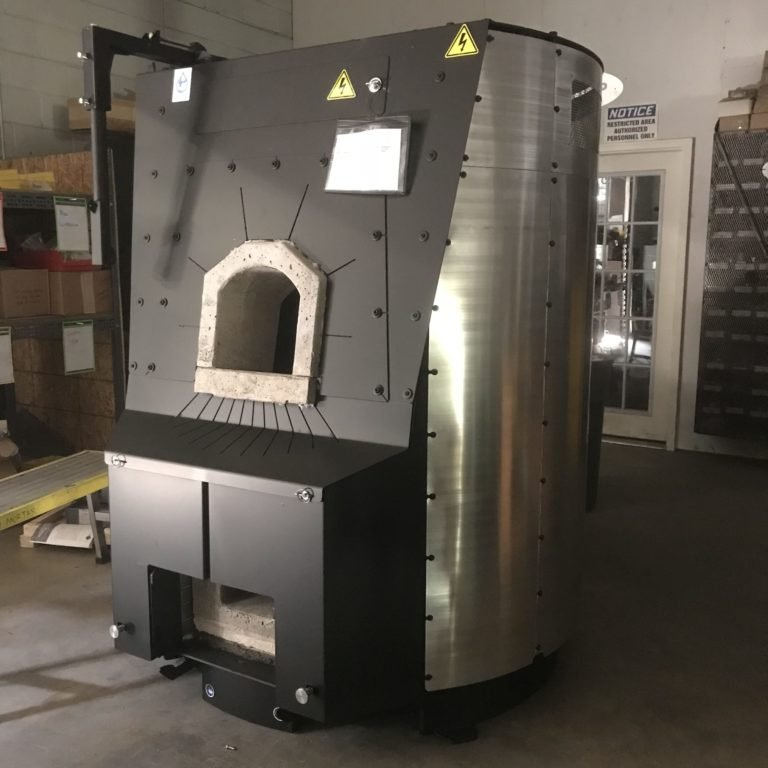
This is an image of a Wet Dog Glass freestanding pot furnace.
Choose freestanding pot furnaces when you need to replace crucibles, often called “pots”, on a regular basis due to melting of colored or highly corrosive glasses. Our freestanding pot models allow the crucible to be placed through the removable front wall. These furnaces feature drain/clean out ports to ease both standard maintenance and cracked pots. Free Standing Pot furnaces can last 10-20 years with good care.
WET DOG RECUPERATION PROJECTS
"Glory hole water heater" is a report on an experiment we conducted in 2010 to try to learn how much heat we could reclaim from glory holes. This heat could be used in many ways, even as a more efficient way to remove the heat from a hot shop in the summertime compared to a larger ventilation system. Or to heat domestic hot water in a school's dorms or in a cafeteria's dishwashing activities.
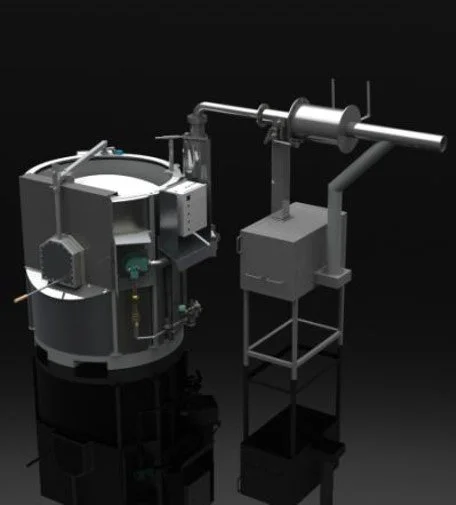
This is a rendering of a system we built to first return heat to the furnace by preheating combustion air; then channel remaining heat into a batch preheater that allowed us to return the heat to the furnace directly via the batch or cullet, which in turn cut charging time and energy by 40%; and when not charging we would direct the exhaust through the cylindrical air:water heat exchanger which allowed us to heat 250 gallons of water to 180F and use that water to circulate through waste veggie oil tanks to preheat it prior to its transesterification reaction which made that more efficient as well. Finally, the resultant exhaust exiting the system was below 200F.
In fact, it was cooled to the extent that the water in the exhaust (Air is 20.9% oxygen and LP gas is C3H8, with the resultant exhaust being 16% H2O) condensed out. We collected between 5-10 gallons of freshly made water per day. It's enough to keep a small landscape watered! Imagine a hot shop in the desert not letting all that brand new water escape along with the exhaust air!
"Preheated Air Percent Fuel Saved" shows an example of how to calculate percent saved based on preheat air temp and the air:gas mixture ratio at a given exhaust air temp. (Eddie Bernard put that document together in 2014)
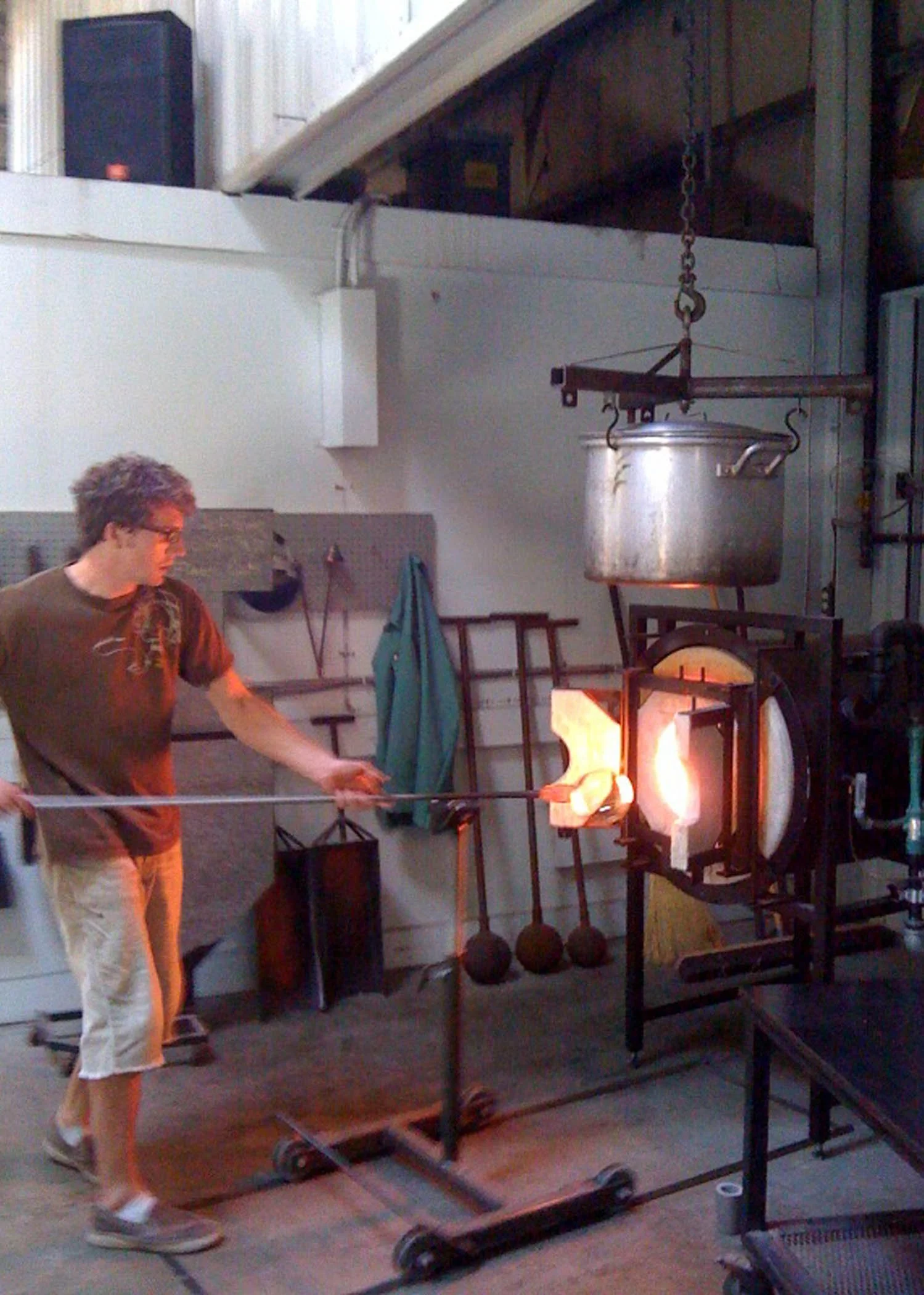
This photo depicts a simple way to reclaim GH waste heat. Eddie was able to brew 10 gallons of beer over a 12" glory hole.
Visit the Wet Dog Glass Tech Portal for more information about their equipment!