Glossary
Below is information about important terms that are used throughout this website for the purpose of proper glass art education.
Annealing Process- In order to avoid thermal shock, molten glass must be systematically cooled in a controlled manner inside of a kiln. Annealing reduces the amount of strain and internal stress in the glass thus enhancing its durability and stability.
Batch Melt- Raw materials such as silica sand, soda ash, and limestone melt together to create clear glass. Other materials such as copper, cobalt, cadmium, and gold can be added to create colored glass. Each color is made up of its own unique recipe. These raw materials are ground into fine particles and carefully mixed together to create a homogenous “batch” which is melted at high temperatures inside The Furnace. Batch Melting may require the use of toxic chemicals and proper safety procedures must be followed, and proper personal protective equipment must be always worn when around these chemicals!
Borosilicate Glass- Different than traditional furnace “soft” glass, borosilicate (Boro) glass has boron trioxide added to its recipe which creates increased heat resistance and durability. It has a low coefficient of expansion which makes it relatively resistant to thermal shock. This makes Boro glass perfect for scientific equipment and cookware. Because Boro glass melts at higher temperatures than soft glass, it is often melted from rods at a stationary flame versus being melted in batch in a furnace and blown in the hot shop studio.
Burner System- The burner system combines forced air and gas in a controlled manner to achieve and maintain high temperatures.
The Blower- delivers forced air to the Burner which is controlled through adjustable valves. It is necessary to keep a good air/gas mixture ratio for a good efficient flame in the furnace.
Castable- also known as Refractory Castable, this non-metallic material hardens without heat and is known for their heat resistance and thermal insulation properties. Castable exists in a dry form and creates a cement-like consistency when mixed with water. They vary in density and application and can be molded into different shapes and sizes according to the needs of the equipment design. Vermiculite, Perlite, Mizzou, and Kaolite castable are often used in studio glass equipment because of their ability to absorb radiant heat and keep the heat where it belongs- inside the equipment.
Colored Glass- Metal Oxides and Compounds such as copper, cobalt, cadmium, and gold are mixed together with the basic ingredients silica sand, soda ash, and limestone using precise recipes to create beautiful batches of opaque and transparent colored glass.
Continuous Melt Furnaces- Typically consisting of two sections (the melting tank and the working tank) the continuous melt furnace is designed to be at high temperatures all day and night 24/7 allowing for stable and efficient production. The melting tank is where the glass is melted and refined. It passes through to the working tank where the glass can be removed for artistic purposes. This furnace is in comparison with the Day Tank which can melt glass in smaller batches. The same glass recipes can be used for both types of furnaces. Continuous Melt furnaces are often designed with energy saving technology such as a Flue Damper, Refractory Insulation, and Recuperation.
Controllers (Kiln)- Kiln controllers are typically powered by electricity and are essential for measuring the temperature and power of kilns. They work by interpreting information from the thermocouples and relaying this information to the relays which control the heating elements. The controllers send signals to close or open the circuit which allows the kiln to warm up or cool down. Automatic controllers are most popular in glass making because it allows the user to enter a Firing Schedule in advance in which the controller executes without the artist having to manually adjust the temperatures.
Cullet- Recycled glass that has been cleaned, sorted, and crushed into small, uniform pieces for reuse in the production of new glass. Cullet is charged, or loaded, into the furnace at high temperatures of around 2300 degrees Fahrenheit and melted for at least 10-12 hours.
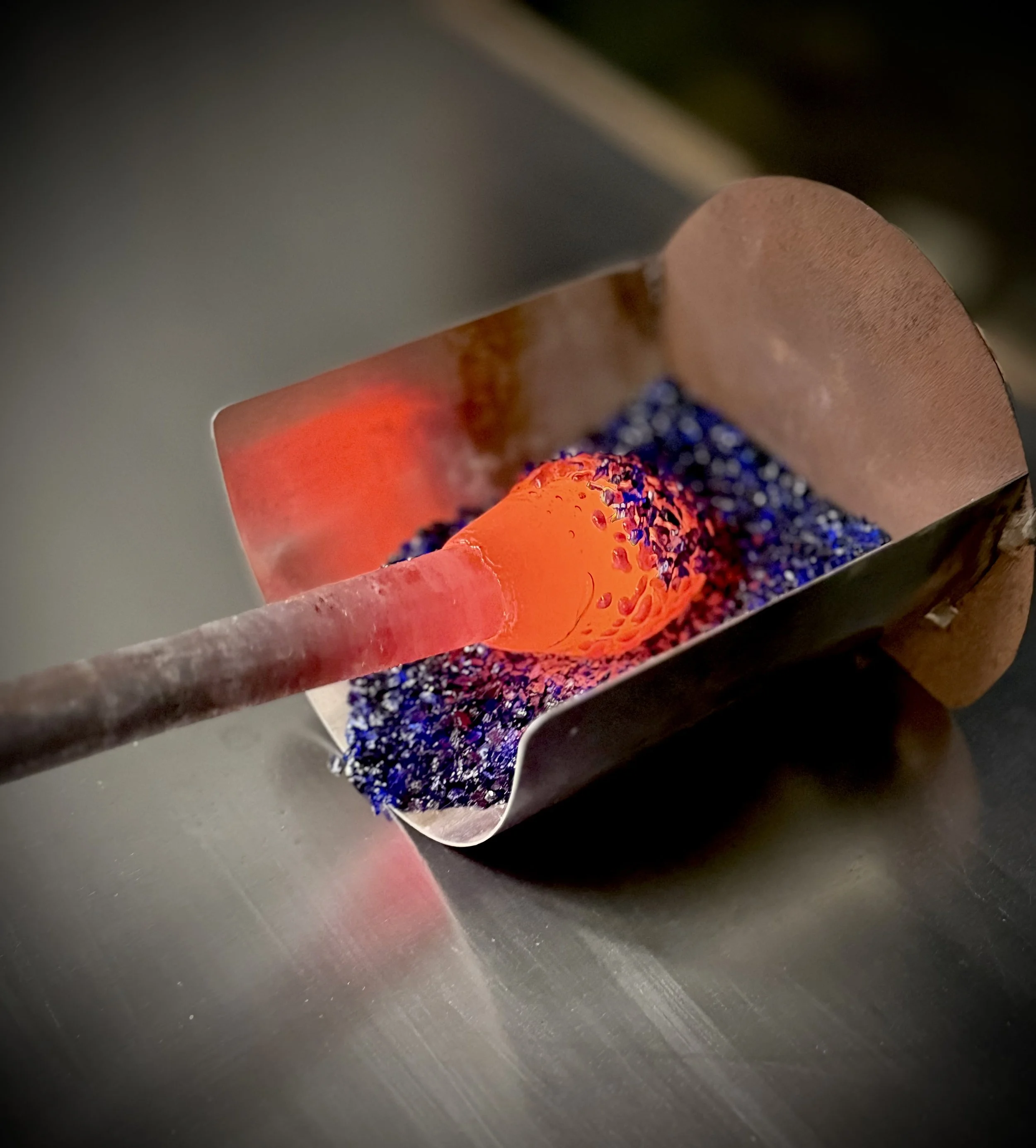
Cullet Melt- Functioning through a similar heating process as batch, this method involves putting small chunks of glass called cullet into the crucible of the furnace for melting.
Day Tank Furnaces- These furnaces are typically smaller, more flexible and versatile than continuous melt furnaces and allow for periodic operation. The structure is similar to its counterpart but instead of a passage between tanks, there is a singular tank with openings for loading and removing molten glass. These furnaces are designed for studios without the demand or space for a large-scale continuous melt furnace.
The Doors- In front of the chamber are typically two hinged doors made from a high heat refractory castable material. The doors help keep the heat inside the reheating chamber and are important aspects of efficiency. Closing the doors when the chamber is not being immediately used can help preserve energy and maintain higher temperatures with the use of less energy.
Electric Furnaces- Electric furnaces operate by using electric energy as the heat source for melting the glass. Typically silicon carbide or Molybdenum disilicate resistance heating elements are installed inside the furnace walls which generates enough heat energy to reach the extreme temperatures required for melting glass. Electric furnaces are usually day tanks or pot furnaces because of their use of crucibles and are insulated using the same refractory materials as traditional gas furnaces.
Firing Schedule- Glass art making inside of a kiln is often a very precise and complicated process that requires a multiple step “Firing Schedule”. The firing schedule consists of steps regarding temperature, rate of temperature change, and hold time of specific temperatures. A typical firing schedule will include a ramp up to a specific working temperature, a hold at that temperature, and then an annealing cycle to properly cool down the glass.
Flue Damper- This mechanism opens the flue at high fire and closes it down at low fire. This helps keep heat in the furnace for more efficiency while preventing pressure issues when you need to bring the furnace up to melting temperatures.
Free Standing Pot Furnace- Inside these furnaces is a large round ceramic crucible (Pots) designed to withstand high temperatures to melt and hold molten glass. Pot Furnaces are typically smaller than the other two designs are used often in batch melting of colors because the crucible can be changed out more frequently. These furnaces are great for small scale art studios and community learning environments.
Furnace- The Furnace converts raw materials such as silica sand, soda ash, and limestone into molten glass by maintaining high temperatures around 2100 degrees Fahrenheit. There are different types of furnaces that are used for different purposes. The main types of furnaces for hot shop glass making studios are continuous melt and batch melt furnaces. They can be powered by oxy-fuel systems or through electricity.
Hard Brick- Hard bricks are more dense than soft bricks. They are mainly made from alumina, magnesia, and/or silica formed by high pressure molding, drying, and high-temperature sintering. Hard bricks have high thermal conductivity which makes them less effective as insulators but are fire resistant which makes them useful in places that experience high mechanical and chemical stress.
Insulation- Insulation refers to materials that reduce heat loss by acting as a barrier against the transfer of heat energy. Heat naturally moves from warmer to cooler areas through conduction, convection, and radiation. Insulation works by impeding these transfers. Insulation materials are poor conductors therefore slowing heat flow. They work by trapping air within its structures thus minimizing convective heat transfer as well. Proper insulation has a direct impact on equipment energy efficiency. These materials are important in the design of The Furnace, The Reheating Chamber, and The Annealer.
The Joule Principle- Joule's Law states that the heat produced by an electric current passing through a conductor is directly proportional to the resistance of the conductor and the square of the current. This principle describes how electrical energy is converted into heat and how that heat interacts with matter, in this case molten glass.
Molybdenum Electrodes- Molybdenum electrodes have an extremely high melting point and are excellent electricity conductors so they are typically used to line the inside of the furnace to generate heat.
Nozzle-Mix System- A Nozzle-Mix System a system where air and gas are delivered independently to a nozzle mix burner where they are mixed at the point of combustion, in the nozzle of the burner.
Pre-Mix systems- air and gas are fed into a mixer, and the resulting mixture is delivered to the burner head.
Recuperation- the recovery and utilization of waste heat energy in glass making equipment such as Furnaces and Reheating Chambers. Recuperators are heat exchange structures that transfers heat from spent air (that typically escapes through the flue) and reintroduces this heated air into the burner. This heated air is then mixed with gas through the use of a nozzle mix burner system. Recuperation can reduce energy consumption and therefore increase energy efficiency by utilizing heat energy that would otherwise be lost.
Refractory- Materials that are resistant to heat and retain their strength and stability at high temperatures. They are resistant to thermal shock and can act as a barrier between the glass and the wall of the equipment. Refractory materials are important in studio glass equipment because they protect against corrosion, provide thermal insulation, and prevent erosion. Zirconia refractories are often used in glass art studio equipment because they have low reactivity with molten glass. Silica refractories are also used often because they maintain their hardness under high temperatures.
Soft Brick- Also known as Insulation Fire Brick (IFB) because of their lightweight and porous structure. They are made from refractory clay, alumina, and organic filling. Soft bricks have low density, low thermal conductivity, and are often used to insulate studio glass equipment because they can easily be cut and shaped to fit into specific spaces such as the Furnace Crown.
Striking Glass- Some glass will appear pale and colorless when in its cold sheet form but when brought to high temperatures the color will “strike” and change to a much different color. This process involves the metal oxide particles added to the glass to dissolve and grow into crystals at the surface. The size of these crystals determines the color because the smaller wavelengths reflect yellow while the larger crystals reflect purples, blues and greens. Striking colors can vary depending on temperature, atmosphere, history of heat, and amount of times heated.
Thermocouple- A thermocouple is an important temperature sensor that can help determine the temperature inside of a working kiln. They are made from two dissimilar metal wires joined at one end forming the “hot junction” while the other end is connected to a measuring instrument forming the “cold junction”.There are many types of thermocouples but the most common used in glass making are Type K.
Let’s Work Together
If you're interested in working with us, complete the form with a few details about your project. We'll review your message and get back to you as soon as possible.